| Home |
About |
Methods |
Studies |
Themes |
| Background Most people have a strong inclination to obey authority figures, irrespective of their religious beliefs, their feelings or intentions. This was first discovered by Stanley Mil gram with his pioneering study into obedience. In his first study he found that 65% of participants would give an apparently lethal electric shock to someone they had only just met, when told to by the experimenter. Interestingly, this percentage remains almost constant when compared with other studies carried out since then. However, the ethical issues that the Milgram study raised has meant that institutional review boards (IRB's) are reluctant to give ethical approval for any study that explores the complex interaction between individuals and authority figures in an experimental setting. Although we know a lot about the mechanisms of obedience, we are left with little understanding of the nature of disobedience to an unjust authority - an act that is vital for social progress. Equally important is that the ethical committees, although they are designed to protect the participants that take part in studies, have held back some of the research into the dynamics involved in reporting wrongdoing to a higher authority (a phenomena known as "whistle blowing"), which is another behavioural option in the face of an unjust authority figure. One question that has never been investigated, is there something different about the people who disobey or even blow the whistle? What are they thinking at the time they are making that decision? Is there a personality trait that makes people more obedient or more likely to disobey? At the time of this study, there is no evidence that can satisfactorily answer these questions. Clearly, one of the first steps to take is to develop a procedure that gives participants the chance to obey, disobey or blow the whistle against authorities who are encouraging immoral behaviours. Such a procedure must also engage the participants and have mundane realism, while at the same time protecting the participants from harm. We have tried to do precisely that, in our present study. Our investigation uses much of the same procedure developed by Stanley Milgram, we too, have an authority figure requesting immoral acts of the participants, but goes well beyond that in that it provides the participants with the option to take personal action against an evil system (in this case an unethical experiment). Because we have included a more psychological approach rather than the physical approach taken by Milgram, we expect that a higher percentage of the participants will obey the the experimenter than in the original study. In line with current thinking, it is felt that in modern societies verbal hostility is more typical than physical aggression in the relationship between individuals and unjust authorities. With respect to those that defy instructions, we think that the level of whistle blowing will be lower because it involves a potential direct confrontation of the defiant person and the authority figure. Moreover, rather than just deciding to exit from the unpleasant situation by refusing to do what the authority tells you, the whistle blower, by challenging him or her directly to higher authorities, must be prepared for future involvement with both the authority figure and the system governing such behaviour. We have tried to do exactly that in the present study. This research, then, uses the generic Milgram procedure as a starting point - authority requesting immoral action of participants - but goes well beyond it in providing participants the option to take personal action against an evil system (in this case, an unethical experiment). Because we use a form of softer, psychological aggression than the physical violence used in Milgram's study was used in this study, we expect a higher percentage of participants will obey the experimenter than in Milgram's baseline condition. We decided not to use information based on interview or archival data that might have been collected a long time after the defiant act. In fact, such data may have transformed into some kind of ad hoc explanations. The alternative of using scenario information is not without its problems. It might be more useful when imagining familiar situations, but when the scenario becomes more complex with unfamiliar elements, it may then be totally inappropriate to ask participants how they might act in such circumstances. In order to explore the extent to which participants' estimated reactions differ from actually experienced ones, we conducted a separate study in which 138 students were asked to predict their behaviour and that of others when facing the same setting designed for our laboratory investigation. Given people's inclination to see themselves as better than others, and considering their difficulty of taking into account the subtle situational forces that can shape human behaviour, we expect, in both cases a substantial overestimation of the tendency to disobey and blow the whistle. Such a result would replicate Milgram's findings of a wide gap between people's prediction of their own and other's degree of (dis)obedience when contrasted with the actual behavioural outcomes in his experiments. Our interest in understanding the personal as well as the social nature of such variations in (dis)obedience has led us to collect a variety of personality and values information from our participants. We have assessed six basic personality traits using the HEXACO-PU-R as well as individual differences in social value orientation using a nine-item Decomposed Games measure to determine if these can be useful in predicting participant's behaviour. Formulation of an hypothesis is difficult. On one hand one might expect obedient participants to be considerable different from defiant participants, these latter being, for example, more honest and prosocial. On the other hand it is impossible not to consider that certain behavioural contexts, like ours, because of their unusual and somewhat extreme nature, are likely to reduce the power of individual factors in predicting participant's behaviour. From this point of view one might expect to find, at best, a weak effect for various personality variable related to the participant's decisions to obey, disobey, or openly defy and authority demanding them to act in unethical ways. Author Bocchiaro, P., Zimbardo, P.G. and van Lange P.A.M. (2012)
"To defy or not to defy: An experimental study of the dynamics of disobedience and whistle-blowing." Social Influence 7. (1) 35-50. Sample A Total of 149 undergraduate students (96 women, 53 men, average age = 20.8 S.D.=2.65) took part in this research in exchange for either 7 euros cash or a course credit. Participants were recruited by flyers posted in the campus cafeteria of the VU University of Amsterdam. Method The authors, like Milgram, claim this study to be an experiment. It is not. Experiments have Independent Variables that change. This is not present. Therefore it is not an experiment. I would suggest a Controlled Observation as the method used. Procedure Pilot Study Before the main study, the authors conducted a series of pilot studies to refine the procedure for the main study and to get feedback from the participants. During the de-briefing interviews the participants had been convinced by the cover story ("I thought it was altogether real......it was a big surprise that it was not true). The general feeling among the participants was that the study was appropriate from an ethical point of view ("Cool and interesting research, good for science"). A total of 92 undergraduate students from the VU University of Amsterdam participated in the preliminary research stage. We received final approval from the IRB of the VU University after the pilot tests were carried out. The next step was to inform those people that were to be used in the main study what they were expected to do, the potential risks and rewards of participation, about their right to withdraw at any time with no penalty, we assured them the information collected would be treated with the utmost confidentiality. They were also informed of an interview which would take part after they had completed their part in the study, where they could ask questions and complete a consent form, which would be signed from the point of being fully informed about the study. Main Study Students attended the laboratory at the appointed time where they were met by a Dutch experimenter who greeted each participant. He was formally dressed and had a stern demeanor, the experimenter proceeded with a (seemingly unjustified) request for each participant to provide the names of a few fellow students, and were then presented with the cover story: "Working with an Italian colleague, I am investigating the effects of sensory deprivation on brain function. We recently conducted an experiment on six participants who spent some time completely isolated, in Rome, unable to see or hear anything. What happened was traumatic, all of the participants panicked, their cognitive abilities were impaired temporarily, some experienced visual and auditory hallucinations. Two participants even asked us to stop because of their strong symptoms, but we didn't because such a decision would have implied collecting invalid data. In post-experimental interviews the majority said it was a frightening experience. Now our aim is to replicate this study here, at the VU University on a sample of college students. There are currently no data on young people, but some scientists think that their brain is more sensitive to the negative effects of isolation. It is difficult to predict what will happen, and I am worried about that .... but I want to go ahead with this experiment. A University Research Committee is evaluating our study. Of course they have high standards and know about the great suffering caused by extended sensory deprivation, so .... I don't know ... we will see what their decision is. In the meantime the Committee is collecting information ... it seems they do not have clear ideas what to do. That's why they are also interested in the feedback from students like you who happen to know details regarding my experiment. You will find Research Committee forms in the next room. Having said all that, what I need is for you to write a statement to convince the students you indicated earlier to participate in my sensory deprivation study. We will send them your testimonial through email. And if this is OK, I will contact you in future for other promotions ... so this means money for you. As you can see, this is a preliminary stage of the experiment, but it is also important to show members of the Research Committee that people do not judge negatively sensory deprivation. I'll be back (the experimenter left the room and stayed out for 3 minutes in order to provide a time for reflection on the action-based decisions about to be made). On his return he said "Let's move into the next room, there is a computer for you to perform the task. Of course, you must be enthusiastic in writing your statement. To this end it is requested that you use at least two adjectives among "exciting", "incredible", "great" and "superb". Also, you cannot mention the negative effects of sensory deprivation (this instruction were also displayed on the computer screen as well). Begin your task; I'll be back (the experimenter stayed out of the room for a full 7 minutes). In this second room participants found a mailbox and the research Committee forms. If a participant believed that the research on sensory deprivation violated ethical norms, he/she could anonymously challenge it by putting a form in the mailbox. After the 7 minute interval the experimenter returned and invited the participant to follow him back into the first room; then he/she was administered two personality inventories, probed for suspicion, and debriefed fully. One of the personality inventories that were completed were the Dutch version of the 60-item HEXACO-PI-R, an instrument that measure the six major dimensions of personality (Honesty-Humility, Emotionality, Extroversion, Agreeableness, Conscientiousness and Openness to Experience). Each domain scale is composed of ten items. In the self-report form that was used in this study, participants were asked to indicate how much they agree with each statement, from 1 (strongly disagree) to 5(strongly agree). The HEXACO-PI-R, was used because its psychometric properties have been well established. Because our procedure created a dilemma in which self-interest clashed with collective interest we chose, as another personality inventory, to measure one of the most studied individual differences relevant to this dimension, namely Social Value Orientation (SVO). SVO measures relatively stable preferences for particular patterns of outcomes for oneself and others by using a nine-item Decomposed Games measure validated in Dutch by Van Lange et al. Prosocial orientation is revealed by tendencies toward enhancing joint outcomes and equality in outcomes; individualistic orientation is revealed by tendencies toward enhancing own outcomes with very little or no regard for other's outcomes; competitive orientation is revealed by tendencies towards enhancing relative advantage over other's outcomes. SVO measures are found to have good test-retest reliability and predictive validity of behaviour in various social situations. This measure allowed us to classify participants as "prosocial", "individualistic", or "competitive" if they made at least six of the nine choices consistent with a prosocial, individualistic, or competitive decision rule. Participants failing to meet this criterion were discarded from the data analysis. Debriefing was conducted with great care and sensitivity. Each participant was informed of the reasons for our use of deception, then we disclosed the true nature of the study (purpose, variables, hypotheses). The experimenter was trained to use simple language and to proceed slowly, from the general to the specific, in order for everyone to be able to process this new information in an appropriate manner. However, because “debriefing a subject is not simply a matter of exposing him to the truth”, we made sure that participants did not feel uncomfortable about their performance (of being obedient) and about the fact they had been deceived. We also took all reasonable steps to minimize the likelihood of loss of trust in future research in which they might be engaged, and/or toward their academic institution (participants were carefully informed about the use of deception in scientific research, the circumstances in which it is permissible/necessary, and the role of IRBs in general and in the present study). After having underlined the importance of our obtaining potential future participants’ natural reactions, current participants were requested to refrain from discussing the study with colleagues and friends. Then they were asked to provide a written informed consent for use of their data. Finally participants were given a written debriefing form that outlined all the details that had been provided orally, as well as an email address to contact in case they wanted to complain or ask further questions about the study. The entire session lasted approximately 40 minutes. Results The researchers were mainly interested in the participants' reaction to the experimenter's request to write the statement in support of the sensory deprivation study. those who complied were considered "obedient"; those who refused were considered "disobedient"; those who reported the experimenter's questionable conduct to the Research Committee were considered "whistle blowers". There were two kinds: Open Whistle Blowers if they had refused to comply with the request to write the statement, and Anonymous Whistle Blowers if they had originally complied with it. Comparison group estimations Before going into details of the main findings, it is worth making a detour and looking at how people predicted they would act and what they thought other people might do in the experimental conditions that were created. When comparison students are asked to imagine being in this research, how likely are they to predict (dis)obeying or whistle blowing? The separate sample of 138 students from the VU University of Amsterdam was provided with a detailed description of our procedure and then asked "What would you do?" and "What would the average student at your university do?" Of all participants in this part of the study, only 3.6% indicated they would obey the experimenter. By contrast, most believed that they would be either disobedient, 31.9% or whistle blowers, 64.5%. When asked to predict the behaviour of other typical students at their University, only 18.8% of participants thought that an average student at VU University would obey, while they believed most other students would respond as either disobedient, 43.9%, or be a whistle blower, 37.3%. These figures provide a backdrop to the results obtained when student participants were immersed in the social situation of the study. The diagram below shows these figures: 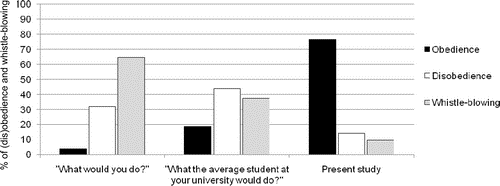 Quantitative Main Findings Results for the laboratory revealed a very different picture to the ones the participants predicted. Of the 149 participants that took part in the study 76.5% obeyed the experimenter (n=114), 14.1% disobeyed (n=21), and 9.4% blew the whistle (n=14). The right hand columns show this in the picture above. Among the whistle blowers 6.0% (n=19) had written a message (Anonymous Whistle Blower) and 3.4% (n=5) had refused to do so (Open Whistle Blowers). When it came to analysis, the whistle blowers were kept as a single group, as dividing them would make the groups sizes small (when the two subgroups were included in the analysis, patterns and significance did not change). Based on the initial data we sought to determine whether there were any factors that could differentiate these three sub-samples (obedient, disobedient, whistle blower). No significant differences were found in any of the groups in relation to gender, X2(2,149)=3.71, p=0.16, religious affiliation (Christian/Islamic), Fisher's exact test, p=0.24 or religious involvement (defined in terms of attending services), Fisher's exact test, p=0.33. A significant difference was instead observed with regard to faith (defined as a confident belief in a transcendent reality), X2(2,149)=6.74, p=0.03. However, although this chi-squared test was significant, none of the standardised residuals associated with the cells reached significance. Hence it is more appropriate to talk of a trend suggesting that whistle blowers have more faith than did the obedient and disobedient participants. A one-way ANOVA was performed to test for individual differences in personality among the three groups. The results reported below show no statistical significant difference in any of the six personality factors measured by the personality inventories. The results are shown below:
We also wanted to know if group differed in terms of SVO. A total of 28 participants (19.8%) were removed because they failed to meet the criterion of six value-consistent choices. Also we excluded another three participants (2.0%) because they turned out to be "competitive". A Chi-squared test showed that "prosocial" and "individualistic" participants were not equally distributed among the three groups. X2 (2,118)=2.25, p=0.32 Several conclusions, as well as some conceptual and procedural issues, arise from the experimental investigation of disobedience to, and defiance of an unjust authority. In the last twenty years much theoretical work and some field theoretical studies have focused on the topic of whistle blowing. However, we believe that our study is the first to examine whistle blowing in an experimental, controlled setting. All participants believed the cover story and were surprised, at debriefing, to discover the true nature of the study. Additional support for the validity of the study comes from the data collected, which are consistent with those reported in other literature as regards similarly high levels of obedience. The Limited Value of Imagined Scenario Research Worth mentioning are several things in the nature of the participant's predicted behaviours, which were collected outside the experimental setting, that differ from those collected from within. When participants predicted how they themselves would behave in this setting, many were confident that they would do the right thing and disobey or even challenge the unjust authority - at a higher rate than they thought other imagined average fellow student. What accounts for this attribution fallacy? An what does it say about the value of scenario studies that have come to replace research on similar conceptual phenomena? Our answer to the second question is to see such alternative research as generating spurious conclusion of limited generalisability. The answer to the first question is a bit more complex because it forces us to focus both inward on the mental gymnastics of ordinary people wanting to appear "good" and outward on the pervasive power of situational forces that bind behaviour to a range of seemingly innocuous features in any given behavioural context. On Being Special and Invulnerable Most of us believe that we are special, above average, guided by moral principles with freedom to act rationally, personally immune to the influence of powerful situational forces. This fundamental egocentric focus seems to generate a "cortical cataract" that blurs the socio-centric focus necessary for recognising our inclusion in ever-changing social contexts. As a consequence of the illusion of invulnerability, it is reasonable to assume that we humans tend to reject, as not relevant, the information that in any given setting most people do what is expected by the people in authority. Paradoxically, by not being able to imagine both the power and influence of professionals and our human tendency "to go along to get along" we make ourselves even more vulnerable to being seduced by perpetrators of evil and confidence men as "easy marks". The data from our scenario study suggests that nearly every participant (96.4%) were victim to this better-than-average phenomenon, given that they predicted that they would either disobey (31.9%) or be a whistle blower (64.5%) in the setting of the created study. Once they had made their prediction, participants tended to project their own beliefs to their own choices of behaviour and judgments as common and appropriate to the existing circumstances, while viewing different responses as uncommon, deviant or inappropriate. Actually, the behaviour of both disobedience and whistle blowing are demanding for people, particularly the whistle blowing response. It has been noted that, in the real world, whistle blowing can be followed by severe financial penalties, if not bankruptcy, sometimes depression or alcoholism. It has been found that nearly half of all whistle blowers lost their jobs. Given the sacrifices made by people, it is often the case that the very thing they "blew the whistle for" does not get changed. From a benefits side of the equation, there is the knowledge that people "did the right thing" by standing up and speaking out when most people were silent in the face of possibly illegal actions. In addition, they may prove to be an example to others, who may also follow their example and carry out similar brave deeds when the opportunity arises. The Predictive Failure of Personality Traits None of the standard tests for individual differences in personality predicted whether participants would obey, disobey, or be a whistle blower. A possible explanation for this could reside in the strong situational forces acting on the participant's behaviour. Research has shown that people behave in completely different ways than they normally do when they find themselves in an unfamiliar environment that could verge on the extreme. It is possible then, that in the experimental environment in this study could have minimised the individual differences between obedient and defiant participants. However, the limited number of whistle blowers and disobedient participants plus the characteristics of the specific tests we used can mean that caution is used when drawing firm conclusions about personality traits not having an impact on obedience or defiance. In fact, a larger sample (n>250, perhaps?) better and more refined tests of personality, that maybe point to a direct theoretical link between personality and behaviour, would have enabled us to more sensitively detect the differences in personality that make someone obedient, disobedient, or a whistle blower, if this difference does exist. Looking back, the reaction of American to the trial of Lieutenant Calley for the massacre at My Lai during the Vietnam War, revealed that people's response to destructive orders is affected by their attitude to authority. It seems that those people who follow the rules and respect authorities'' demands, and those who faithfully obey the government, tend to deny individual responsibility and to obey authoritative orders. In contrast, those people who see it as their role to take part in formulating, evaluating and questioning national policies tend to assert individual responsibility for crimes of obedience and to disobey commands that violate the individual's own moral principles. The Issue of Responsibility It is a generally accepted fact that people are responsible for their own actions, even when there are outside influences on them. Milgram's participants lost the right to be unconcerned with the moral implication of their actions, just as the German State's demands became immoral. Milgram;s obedient participants and Hitler's murderers ought to have seen that these institution were no longer legitimate, could no longer claim their loyalty, and could no longer settle for them the question of moral responsibility. Obedient participants in our study justified their behaviour by allocating personal responsibility to external forces ("It was expected of me, that's why I continued", "I co-operated because the experimenter asked me to", "That was the task, so I executed that"). It was a self-serving absolution, an easy way of escape from an unexpected and stressful situation. On the contrary, such and "agentic shift" did not occur to defiant participants, who felt responsible for their action inside the laboratory ("I don't want to do unethical things, I would be very disappointed in myself", £I disobeyed because I felt responsible towards friends", "If the experiment would really hurt people, I wouldn't want to be responsible for that"). Courage is Hard to Muster The findings clearly indicate that moral behaviour is a major challenge for people, even when it appears, to observers, that it can be one of the easiest paths to follow. The researchers tried to make it easy for people to defy the experimenter. Participants could end their participation at any time without penalty, by just saying, once, "No!" the task did not require to increase their response, as Milgram did, they were made aware, at various points, that the experiment on sensory deprivation was ethically questionable, they were allowed a considerable time for reflection, and finally, the potential victims were not anonymous others, but their own friends and fellow students that they had nominated. Despite all of these chances it proved difficult for the participants not to comply with the authority's request to lie and to involve other people in a potentially dangerous study, so difficult, that, in the author's view, both disobedience and whistle blowing can be seen as noble and courageous acts. Defiance, in both forms, was related to a severe restriction of freedom and autonomy. Participants took for granted that they were free to choose the words and, at least to a certain degree, the general tone of the message. What actually happened was the opposite, a scenario that ignited in some participants a state of psychological resistance ("I did not see harm in writing the message, but leaving out the negative information was unacceptable to me", "I was fine until I read that negative consequences could not be mentioned. Then I did not feel good", "My decision, to blow the whistle, was influenced by the demand to leave out the negative consequences in the message"). For disobedient participants, disobedience itself was probably "the greatest moral act" to perform against an unjust authority. It seems that, once they refused to obey, they showed a kind of "autistic" behaviour that prevented them from investigating further about the mailbox or the Research Committee forms. As mooted by our experimenter, most of the time such a strong decision happened in the first room and it was followed by a general lack of interest and attention to social stimuli (i.e. they avoided conversation and eye contact with him). The 21 disobedient participants may have not understood that in certain circumstances, such as the one that they were in, something more could have been done. This is what could have made the difference between disobedient participants and whistle blowers, the latter being more alert to the hints we had given. Further research is necessary to disentangle this issue and other issues linked with, which aspects of defiant participants have they in common. In the current study it seems that all the participants proceeded by making the same comparison between external demands and internalised moral standards. Eventually, the decision was made not to obey an external authority, but an internal one, a moral value that was regarded as the highest authority in charge. To indicate this point, a disobedient participant said "I would be very mad and disappointed in myself if I would cooperate, because it (the experiment on sensory deprivation) is unethical and goes against my principles." Another disobedient participant stated "I thought it was unfair and mean against the people that would receive the message." A Whistle blower said "I did not want to have the harmful consequences weighing on my conscience, so I felt obliged to do this." We therefore have to agree with the statements made by Van Doesum, who noted that when people are confronted with demands they perceive as unjust, the question is not whether to obey an authority or not; the choice that matters is which authority to obey. The one making the demand or the one that would disapprove of the consequences. Basically, it is a matter of hierarchy. |